


Page 50 - Ritz Issue 50
P. 50
                       organisation of the 1954 Diaghilev ALASTAIR Exhibition in Edinburgh and then London,
_Ml\CAULAY (and his book about that, In Search of Diaghi/ev, a beautiful book now costing
DA:NCE
This year I'm full of New Year resolutions. I shan't repeat them to you, in case I break them later and you reproach me. But bear in mind at least that this year I mean to be good.
"I will try to do better" is the very last phrase of a new book of ballet criticism - the criticism of RICHARD BUCKLE. Buckle is a man of many facets. 111·1939he founded and edited a magazine called Ballet, which after two i5sues he left dormant for the duration of the War. Came peace and he re-established it at once; and for some seven or so years it was the most loved and innuential of ballet magazines, until it had to declare itself voluntarily bankrupt.
"Ballet had behind it the personal courage necessary for elegance," wrote the great dance critic EDWIN DENBY in "Obituary for 'Ballet'', "The magazine tried for distinction of appearance and
of character that ballet itself demands, and it maintained that effort under every conceivable difficulty." Buckle, who was also in those years ballet critic for The Observer, described many of those difficulties, and the story of the magazine and of its many contributors of note - writers, photographers, artists - in the autobiographical Adventures of a Ballet Critic. The book is witty, occasionally outrageous and incidentally a fine picture of a whole way of life in post-war London. As they say it's "a good read", and as they also say, it's "very dear".
I mention all of this because in that obituary for 'Ballet·. Denby gives a fine tribute to Buckle's work. "'Ignorant', 'irresponsible', 'snobbish', 'effete', 'unpatriotic' - a string of adjectives by which one comes to recognise the presence of a critic of value - were hurled at its editor, Richard Buckle, more often and more vehemently than at any dance critic
in English. A more honest word for his way of writing and of editing would have been 'aristocratic'."
It may be Buckle's tragedy that by 1955 he had done the greatest work of his life, namely, the foundation and edition of Ballet, the Adventures of a Ballet Critic, the
£20 if you're lucky enough to find a copy), as well as his work for The Observer. He then gave up ballet criticism, determined, he writes, "to give up writing about ballet 'for ever'," only to resume it for The Sunday Times in '59. The next 16 years he became known as the "dandy" of ballet critics, as outrageous as could be and still as aristocratic; he also organised the '64 Shakespeare Exhibition, and published his major biography of Nijinsky. The fracas when he left The Sunday Times in '75 was the feast of Private Eye's columns.
For some people Buckle is the great critic of the post-war era of British dance: I have a suspicion that. that's what Buckle himself thinks. In his obituary of ARNOLD HASKELL in The Times late last year, his final word was that Haskell's recommendation for a healthy life was "Buckle for Breakfast". It takes quite something to turn an obituary into a self• advertisement, and I find it more outrageous, and less endear, ng, than anything he wrote in his ballet criticism.
You can see why Buckle is admired. The prose is lucid, with a constant rhythm that governs the shape of a phrase, a sentence and a paragraph. Of GEORGE BALANCHINE's choreography he writes "Like a diver he plunges into the dark depth of music and comes back quietly with a pearl." Of MARGOT FONTEYN as Ondine "The playful dance with her own shadow is incomparably pretty; and the pseudo-solo, in which, invisibly manoeuvred by a strong arm, she appears to be sporting sadly in the waves like a lonely dolphin, is an invention and a delight. Never have her limbs seemed more expressive or her line more heart-felt. The character she projects, alternately fond and soulless, is that of an incorporeal kitten playing with water and air."
Buckle at the Ballet (published by Dance Books at £8.95) is a book where you can easily put in a thumb and pull out a plum, such as these. But some of the plums, though always expressed felicitously, are of no value except to Buckle's own Bucklemania. The first three paragraphs of his review of the premiere of ASHTON's La Fille ma/ gardee are just one of the umpteen examples of his knack at putting
in himself at many points. He's an
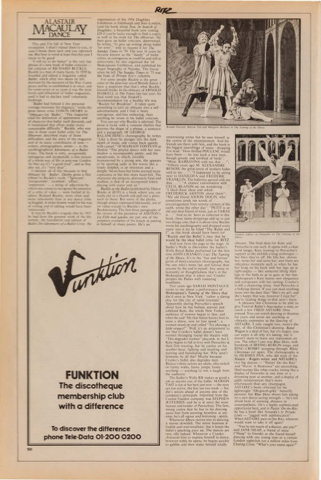
Ronald Plai.<ted.Marion Tait and Margaret Barbieri in The Taming of the Shrew
50
FUNKTION The discotheque
membership club with a difference
Todiscover the difference phone Tele-Data 01·200 0200
entertaining writer but he sees himself as the centre of the entertainment. And his friends are there }Vithhim, and the book is the biggest assemblage of name • dropping I've read. "How thrilled POULENC would have been - he was such a nice man, though greedy and terrified of birds"; "Mme. KARSAVINA told me that ... "; "Fifteen years ago M. ALEXANDRE BENO IS, the great-uncle of modern ballet said to me ... "; "I happened to be sitting next to DANILOVA and FREDERIC FRANKLIN. The ballerina agreed with me that ... ": "A chance conversation with CECIL BEATON set me wondering ... ":
"I liked these ideas and asked FREDERICK ASHTON about them"; "My old friend ANTON DOLIN, who sometimes sends me words of encouragement from remote corners of the earth, wrote the other day": "PETIT is an old and dear friend of mine, just as TA RAS is ... " And so on. Seen as collected in this book, these name-droppings add up to just two things: one, that it is about time Buckle wrote his autobiography and dropped every name into it (to be titled "The Ballet and I", as this book should have been) (or "Buckle and the Ballet''); two, that he would be the ideal ballet critic for RITZ.
And now from the page to the stage. At Sadler's Wells in December the Sadler's Wells Royal Ballet performed for the first time JOHN CRANKO's 2-act The Taming of the Shrew. It's in the "fast and furious" genre of demi-caractere choreography, but the one who's more fast and furious than anyone by the end is myself. Any sense or humanity or thoughtfulness that's in the Shakespeare play is taken out; Cranko peoples his Padua with roistering hoodlums.
Two years ago SARAH MONTAGUE wrote to me about a performance of Shakespeare's Taming of the Shrew that she'd seen in New York: "rather a daring play for this city of rabid feminists". Apparently during Petruchio's speech about how he has bullied, starved and subdued Kate, the whole New Yorker audience of women began to hiss; and when he said "He that better knows how to tame a shrew, now let him speak", a woman stood up and yelled "Try showing a /i11/erespect!". Well, it's an amazement to me that Cranko's ballet doesn't have women thronging round the theatre with "This degrades women" placards: in Act I, Kate begins to fall in love with Petruchio at their first meeting, but he carries on for another hour, fighting and insulting and starving and humiliating her. Why aren't feminists by all this? Maybe because Cranko's ballet also degrades men. Bianca's three suitors are idiots, who switch on funny walks, funny jumps, funny anything - anything to win a laugh from the audience.
The Sadler's Wells RB makes as good a job as anyone can of the ballet. MARION TA IT is not at her best just now - the eyes are too active, the feet are too weak - but she's streets ahead of anyone else. of the company's principals. Imported from the
Covent Garden company was STEPHEN JEFFERIES: and he is at once the most human and tender of Petruchios. The firm, strong centre that he has to his dancing saves him from seeming heartless at any time: he's all vigour and brimming• spirits.
Wh.enever Shrew moves into its dancing, it moves downhill. The mime business is foolish and over-emphatic: but it keeps the ballet's spanking pace up. The dances are very silly indeed. Whenever a Cranko character tries to express himself in dance, however nobly he opens, he begins quickly to gabble and then make himself totally
Stephen Jeffries as Petruchio in The Taming of the Shre,,.
obscure. The final duet for Kate and Petruchio is one such. It opens with a clear lucid image, Kate trusting to Petruchio's support as she unfolds a long arabesque - but then they're off. He lifts her, shoves her, twists her and turns her; and there are ridiculous moments such as when he has her lying on his back with her legs up at right-angles - like someone lifting their legs in the bath so as to gaze at her feet. Shakespeare's Kate learns new eloquence and composure with her taming: Cranko's is still a chattering ninny. And Petruchio is a bullying dimwit. If you can read anything more into the duet than "She's my girl, and she's happy that way, however I treat her", you're reading things in that aren't there.
A pleasure this Christmas to be able to give Festival Ballet's Nutcracker a miss, to catch a few FRED ASTA IRE films instead. You can watch dancing in theatres for years and never see anything as vibrantly expressive asthe dancing of AST A IRE. I only caught two, more's the pity, of this Christmas's showing. Band
Wagon is a deal of fun, but it's stagey; you can enjoy it all why it's lasting, but it doesn't seem to leave any impression on you. The other I saw was Blue Skies, with hundreds of IRVING BERLIN songs, and BING CROSBY scooping through White Christmas yet again. The choreography is by HERMES PAN, who did most of the Astaire • Rogers series: and AST AI RE's two big dances - "Puttin' On the Ritz" and "Havin' A Heatwave" are astonishing. Heel-stamps like whip-cracks, timing like a display of fireworks at one time or a dreaming poet at another, and a display of giddy temperament that's more
effervescent than any champagne.
ASTA IRE's been criticised for his lightweight "Oh-geeoh-golly" butterny persona: but Blue Skies shows him taking on a new dance-acting strength - he's not afraid here of seeming abrasive or unsympathetic. He's a highly sophisticated opportunist here, and in Pullin' On the Ritz. he has a heart like Amanda's in Private Lives - "jagged with sophistication". When ASTA IRE puts on the Ritz, whoever would want to take it off again?
"You're not much of a dancer, are you?" said JANE HEAP, a friend of mine ("Heap" to friends) as she found herself dancing with one young man at a certain London nightclub not a million miles from Charing Cross. "What's your name again?"


