


Page 47 - Ritz Issue 50
P. 47
                    DOMINGO, a PAVARQTII, a- COSSUTTA or a CARRERAS, a CAPPUCILLI or a B'RUSON, l:30 may not be wasted. Was it worth it this time? l'll wait until I see a second performance - one less disastrous, pray God - before I answer that one.
fuming.
Later there were moments when
suddenly the whole dilemma of Mozart's characters became clear and poignant - as when BALTSA yielded to the advances of the disguised THOMAS ALLEN. But when TE KANAWA as the sister with more conscience and the more anguished
walk, silly singing and all.. But with those performers who are real 'artists and were prepared to give themselves to the drama, there were passages of real stage excellence. In particular PLACIDO DOMINGO as Hoffmann luimeme and AGNES BALTSA as Giulietla.
house style amid all the razzmatazz caused by operamanes who're really just name- droppers. Who knows? DOMINGO and Hoffmann do return next season, we know that much. And for those of us who like to
join with Romantic poeturi losing our souls in pursuit of one woman after another, What news that is.
s
My hopes were high for the revival of
DOMINGO has become the only tenor Cosifan tutle, The Opera House has a high dilemma of the two, came lo the same on the international circuit who demands
reputation for its Mozart playing: it's worth
remarking - in case anyone hasn't already torpid. It's still less than ten years since TE every appearance, and at the Garden we've
noticed - that its Mozart performances (like its equally fine Britten ones) feature many British singers. COLIN DAVIS conducted, and as the overture proceeded I found myself admiring his merits as a Mozart conductor all over again - good tempi, consistent rhythm, never a routine or careless phrase. Other conductors bring much clearer texture of playing: but he brings life, wit and thorough ensemble to Mozart. For which all thanks.
The first scene went fine. The JOHN COPLEY production is in its thirteenth year and is probably the one of his that survives longest. It boasts d~cor by HENRY BARDON and DAVID WALKER never obtrusive and constantly ravishing, reaching, in the last scenes, a meeting-point between Watteau-esque rococo elegance •and Turner-style
Romantic light and atmosphere: which is entirely right for the opera, which was composed in 1790, a time when MOZART was increasingly heralding the Romantic movement which would soon sweep over music and all the arts. In the first scene the three British men sang and interacted with wit and spontaneity; as Ferrando and Guglielmo agreed lo amuse themselves by testing the fidelity of their fiancees, you could feel the tightening of dramatic tension.
Then something went wrong. COPLEY's production has been revived by him with a different emphasis each time I've seen it; but I've never known him realise the deeper feelings of the drama and the more serious .possibilities of it. Basically he sees the opera's story as a joke that gets out of hand: but he jokes so doggedly that it's impossible to take the characters seriously.
KANAWA shot to stardom at Covent Garden for her beauty and ease of voice, her elegance and style on stage and her eloquence, as the Countess in Mozart's Figaro; sometimes she seems hardly to have advanced al all since then.
seen him growing in stature visibly in the last two or three years. His Hoffmann was the Romantic poet personified, never better than in his distraught and drunken appearance in Prologue and Epilogue. •
BALTSA had the luxurY,of opening in the ravishing Barcarolle duet (with CLAIRE POWELL). "Belle nuit, o nuit d'amour" indeed. She lies back on a bed of cushions amid a scene of decorous eroticism and lets that lovely voice - clean-edged, sophisticated, vibrant - pour out into the evening air. She has also the best French ahd the best figure of thi: cast.
FRANCE LYNN
moment of yielding, ii was dramatically
to be taken completely seriously on his
She has still the most extraordinary ease
of vocalisation: there's not an element of
strain. And the voice itself is both creamy
and crystalline. But it was like that ten
years ago. TE KANAWA can be an
entrancing stage figure, brimming with
impetuous emotion and alert with keen
expression. As Fiordiligi in this Cosi, she
was lovely, lovely, lovely, and dull, dull,
dull. Individual words were of no account,
rhythm was slack, phrasing was blurred.
Much the same could be said of THOMAS
ALLEN, her Guglielmo. The two of them
are perhaps the two finest singers to grow
up through the Royal Opera company into
international acclaim: why did they seem so
stagnant? The most effective player in this LUCIANA SERRA as the doll heroine
'RAGING BULL' (Cert. 'X') produced by IRWON WINKLER, ROBERT CHARTOFF, directedby MARTIN SCORCESE, based on JAKE LA MOTTA's autobiography,co-authoredby JOSEPH CARTERandPETER SAV.AGE,screenplayby PAUL SCHRADER, editorTHELMA SCHOONMAKER, productionmanager JAMES BRUBRAKER, directorof photographyMICHAEL CHAPMAN. Starring ROBERT DE NIRO, CATHY MORIARTY, JOHN PESCI etc. 2 hr. 9 mins. long. Distributedby United Artists. Opens February19 at Classic Haymarket, Classic Chelsea, Studio Oxford Street, Gate Notting Hill Gate, Screen On The Hill.
'Raging Bull', shot in black and white, is a perfect vehicle for ROBERT DE NIRO's unsurpassed acting talents. Portraying JAKE LA MOTTA, ex-middleweight boxing champion of the world, DE NIRO metamorphasises throughout the film's duration, from a slim, healthy boxer into a fat broken-down, middle aged has-been. Even his false battered nose, the most expensive since JOSE FERRER's 'Cyrano
Cosi was the least accomplished singer ~ RICHARD VAN A'.LLAN: he distorts vowels but he·enounces distinctly and gives full value with the very lightest touch imaginable.
Olympia. Her aria of clockwork coloratura "Les oiseaux dans la charmille" was with the Barcarolle, one of the two moments when I "tingled" with pleasure. The third heroine, Antonia, has an aria as fine as their
BAL TSA provided the most moving numbers ("Ella a fui, la tourterelle") but it moment of the Cosifan tutte. She was also was hard to recognise it as such under the the mosr glorious asset of the distaff side of breathy, wobbly mannered d'elivery of
the Royal Opera's new production of The ILEANA COTRUBAS.
Tales of Hoffmann. It's a flawed opera of uneasy structure, and while I was in the house I was only aware of two numbers that engaged my interest in particular. But the opera as a whole seizes the imagination, and so it did this December at the Garden.
The new production is by JOHN SCHLESINGER. It's his first entry into opera, and a successful one. It's stylish and tasteful: if it could be more imaginative or pointed, it made no blunders and tells its narrative with clarity and dramatic tension. A pity that he lets GERAINT EVANS do Coppelius as an angry brother to his
COTRUBAS has been a favourite house
KIRI TE KANA WA and AGNES
BALTSA were encouraged to play the
sisters like a pair of silly dimwits and when
they heard the cry of "si muora!" ("We're
dying!") but remained seated and sweetly
and lazily took off their hats, I was just Dulcamara in L 'E/isir - silly coat, silly time may help to build up a more settled divorced his first wife for. Eventually, his
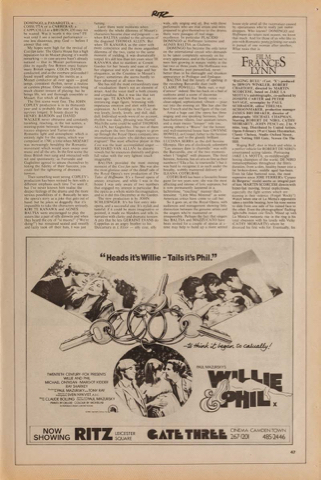
NOW SHOWING
RITZLEICESTER SQUARE
&•TI.TIii.i.
CiNEMA·C·AMDENTOWN
'' Headsit'sWillie-Tailsit'sPhil.'' ::r:·;;;.. •.
TWENTIETCHENTURY-FOXPRESENTS. WILLIEAND PHIL
MICHAELONTKEAN• MARGOTKIDDER RAYSHARKEY _
Proo..c~ PAULMAZURSKaYnd TONYRAY \' ~~SVEN NYKVIST,A.s.c. \"'
""'/;;CLAUDEBOLLINGt.~~"[;:;PAUMLAZURSKY\ "'
PRINTSBYDELUXECOLOUR BY MOVIELAB IN FII\PERBACFKROMCORONET800l(5
~ • foll L,.J.
\ X ·,,
.....
·'II'
©morwenhethCettuv
Amid a huge cast (the opera has three singing and one speaking heroines, four bass-baritone villains, four assistant tenors, and a main mezzo "trouser" role too, among others) a "Bravo" for the honest and well-mannered house bass GWYNNE HOWELL as Crespel, father to the heroine Antonia, and to the glassily brilliant
guest for ten years now; she was the most de Bergerac' model seems an integral part
affecting and intense of lyric sopranos, but is now permanently lannered in a lachrymose, "touching" manner that's tiresome. "Little Miss Minimal" as some American critics have come to call her.
So it goes on, at the Royal Opera, with audiences and management showing little distinction between the genuine artists and the singers who're mannered or • irresponsible. Perhaps the fact that singers· like BALTSA and MAZZUCATO have been invited for a couple of operas 'at a
of him. MARTIN SCORCESE directs with hyper-fast moving, brutal explicitness, especially the fight scenes which are stunning in their violence. (Forget 'Rocky'!) Watch when one of La Motta's opponents takes a terrible beating; how his nose seems to slide from one side of his ruined face to the other. Even the photographers' flashing
PAULMAZURSKY'S
FILM
light-bulbs makes one flinch. Mixed up with La Motta's meteoric rise in the ring is his total obsession with his lovely wife Vicky (CATHY MORIARTY) whom he
267·120I
\' . \'
) '' '' \
I II I, •l
485·2446
'.'
47
.,


